



From Awareness to Architecture: How Boards Can Build a Geopolitical Risk System
Once boards prioritise managing geopolitical risk, how can they successfully move from diagnosing a problem to designing a plan of action?
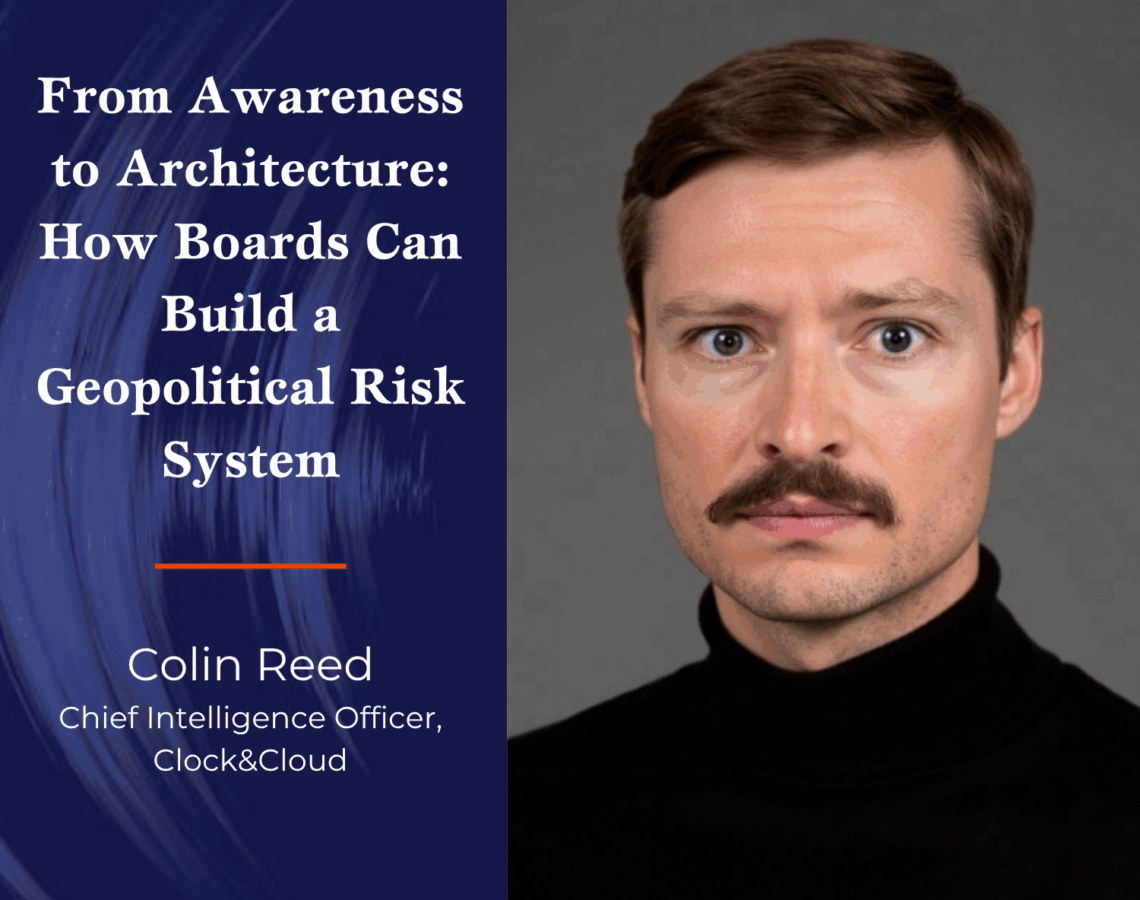
In this podcast, Dr Sabine Dembkowski, Founder and Managing Partner, is once again joined by Colin Reed, Chief Intelligence Officer at Clock&Cloud, a software startup transforming how large enterprises manage geopolitical risk. Colin brings his experience as a US intelligence analyst and as the architect of Salesforce’s geopolitical risk management function to the conversation, revealing how boards and leadership teams can translate geopolitical complexity into actionable insights.
“Building around competencies already in place is a much superior method to contracting for an external problem-solver to come in and do it on your behalf.”
Colin recommends starting with an audit. No business is truly at zero when it comes to managing geopolitical risk. Find out which managers and functions are already managing risk at a tactical level and use them as building blocks.
“This is the biggest failing of the current consulting-based approach to this problem – it assumes that what works for one company will work for another.”
Consultants and outside experts can be useful, but they are not always the best for managing geopolitical risks. Instead, Colin recommends bringing multiple functions together – legal, supply chain, procurement, marketing, security – to form a working group that meets quarterly. Share strategic insights, bring in current-events speakers or special-topic experts, and then start gathering knowledge about where risk is manifesting in each area to inform a highly customised, forward-looking view of the company’s true geopolitical risk profile. No outside consultant can replicate this kind of deep company understanding, and it becomes the foundation for meaningful mitigation and a true competitive advantage.
“Identifying the internal fragility is the best way to focus attention on where global risk might actually break the company. If you don’t approach it this way, you spend all your time chasing the news cycle, which is broad and full of scary things, but only a few of which are probably truly scary to your firm.”
A firm’s unique risk profile is the best insurance against noise and unnecessary expense. Large firms can overspend on mitigation or miss a big risk and still survive. Mid-size and smaller firms don’t have that grace. Focusing on real, specific risks is a more affordable and sustainable model for closing the gap than worrying about everything.
“The institutional muscle needs to be there already and running all the time. If you wait until there are issues, the problems will be outsized compared to if you were able to detect them early.”
At a bare minimum, companies need to care about and prioritise geopolitical risk. A little time spent consistently beats out a crisis reaction, even if only partial solutions can be developed with the available resources. Systems, processes, and open lines of communication help all the time, and are especially valuable to have in place well in advance of a big crisis.
The top three takeaways from our conversation for effective boards are:
- Despite the number of people claiming to be experts, nobody has solved geopolitics completely. Experimentation and change will be necessary.
- Connect with industry peers to share best practices and learn.
- Board members should take an interest in history – there’s a sense we live in unprecedented times, but things have been chaotic before. Everyone benefits from the grounding historical perspectives provide.
Come Join the Better Boards Community
We’d love to get to know you! If you’d like to become part of the Better Boards community, discover our unique approach, and explore ways to work with us or share your ideas on The Better Boards Podcast Series, drop us a line at info@better-boards.com
Remember to subscribe and never miss an episode of the Better Boards Podcast Series. It’s available on Apple, Spotify, or Google.
To find out how you can participate in the Better Boards Podcast Series or for more information on Better Boards’ solutions, please email us at info@better-boards.com.
