



Selecting the Chair: Governance Lessons from the US and the UK
Chair succession is handled differently in the US and the UK. However, both approaches have merit, and there are key principles that matter regardless of geography.
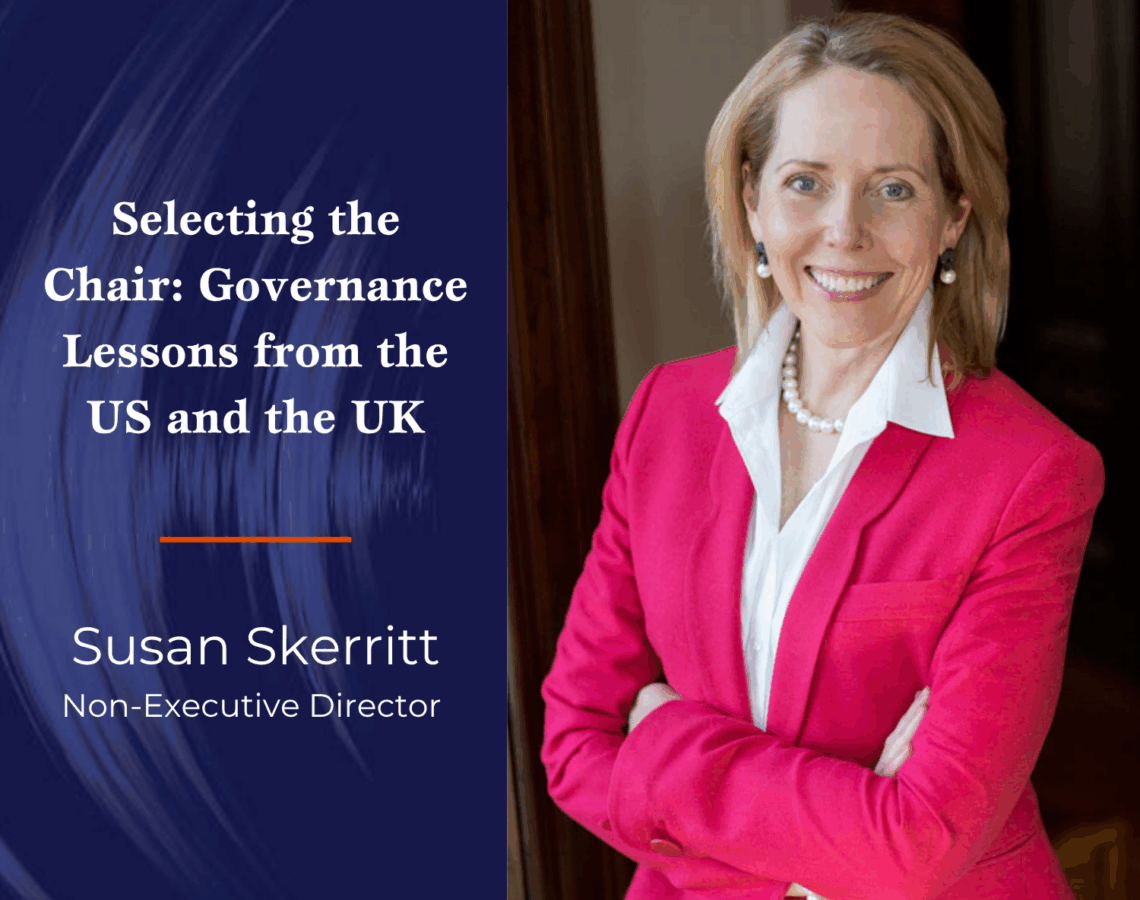
In this podcast, Dr Sabine Dembkowski, Founder and Managing Partner, is joined by Susan Skerritt. Susan is a Non-Executive Independent Director on the boards of Citibank Europe PLC, Tanger, Inc., and IG Group PLC. She previously served on the boards of Royal Bank of Canada US Group Holdings, Community Financial Systems, Inc., VEREIT, and Falcon Trade Group. Before her Board career, she had a successful 35-year financial career and served as the Chairman, CEO, and President of Deutsche Bank Trust Company in the US.
“Procedural differences reflect genuinely different governance philosophies.”
To Susan, the differences between the US and UK approaches reflect the differing philosophies at play. The US model is rooted in the idea that Boards are best positioned to govern themselves. So, the Board Chair is almost always selected from existing Directors, with the process managed internally. The Chair and CEO roles are often combined, and there is a deep resistance to “governance by checklist” regulations.
The UK model places greater weight on structural independence and investor accountability. The current code was built after corporate failures in the 80s and 90s and holds that self-governance without structural safeguards is insufficient. There are term limits, rules about external candidates, and separate CEO and Chair roles. It’s not wholly prescriptive, but “comply or explain” dominates.
“The strengths of one approach tend to illuminate the weaknesses of the other.”
In the US, Susan sees that internal candidates, who already know the company, its strategy, culture, and management team, can reduce transition risk. This is valuable in fast-moving situations and reduces search costs. Plus, internal candidates have established relationships and a track record with management that foster trust and candour from the start. The downsides are insularity, cultures of deference, and a lack of external benchmarking.
In the UK, those potential downsides are addressed. The formal process carries a mandate for independence from the new Chair and searches a wide talent pool for the best candidate to meet a carefully vetted list of needs. However, there’s a risk the search becomes an expensive, time-consuming theatre. There’s also transition risk if the new Chair can’t fully integrate with the company culture.
“Regardless of which governance tradition we’re working within, there are three principles that matter.”
To Susan, three principles matter most. First, Boards should know what they need and not reach for what they’ve always had. The most common failure in Chair succession is a default to continuity.
Second, process quality matters as much as outcome. Susan views this as the UK’s greatest contribution to the global governance conversation. A well-designed search process is rigorous, transparent, and defensible. It surfaces assumptions, creates a record, and signals to shareholders that the Board is taking the decision seriously.
Third, succession planning is not an event. It’s an ongoing discipline. Effective boards keep succession on the live agenda, actively managed and not derailed by unexpected departures.
The top three takeaways from our conversation for effective boards are:
- Structure matters, but it isn’t everything. The issue is always whether the Board is exercising genuine, independent judgment.
- The US and UK models are converging and getting better for it.
- Chair succession is a government bellwether.
Come Join the Better Boards Community
We’d love to get to know you! If you’d like to become part of the Better Boards community, discover our unique approach, and explore ways to work with us or share your ideas on The Better Boards Podcast Series, drop us a line at info@better-boards.com
Remember to subscribe and never miss an episode of the Better Boards Podcast Series. It’s available on Apple, Spotify, or Google.
To find out how you can participate in the Better Boards Podcast Series or for more information on Better Boards’ solutions, please email us at info@better-boards.com.
