



Beyond Governance: Understanding Human Performance in the Boardroom
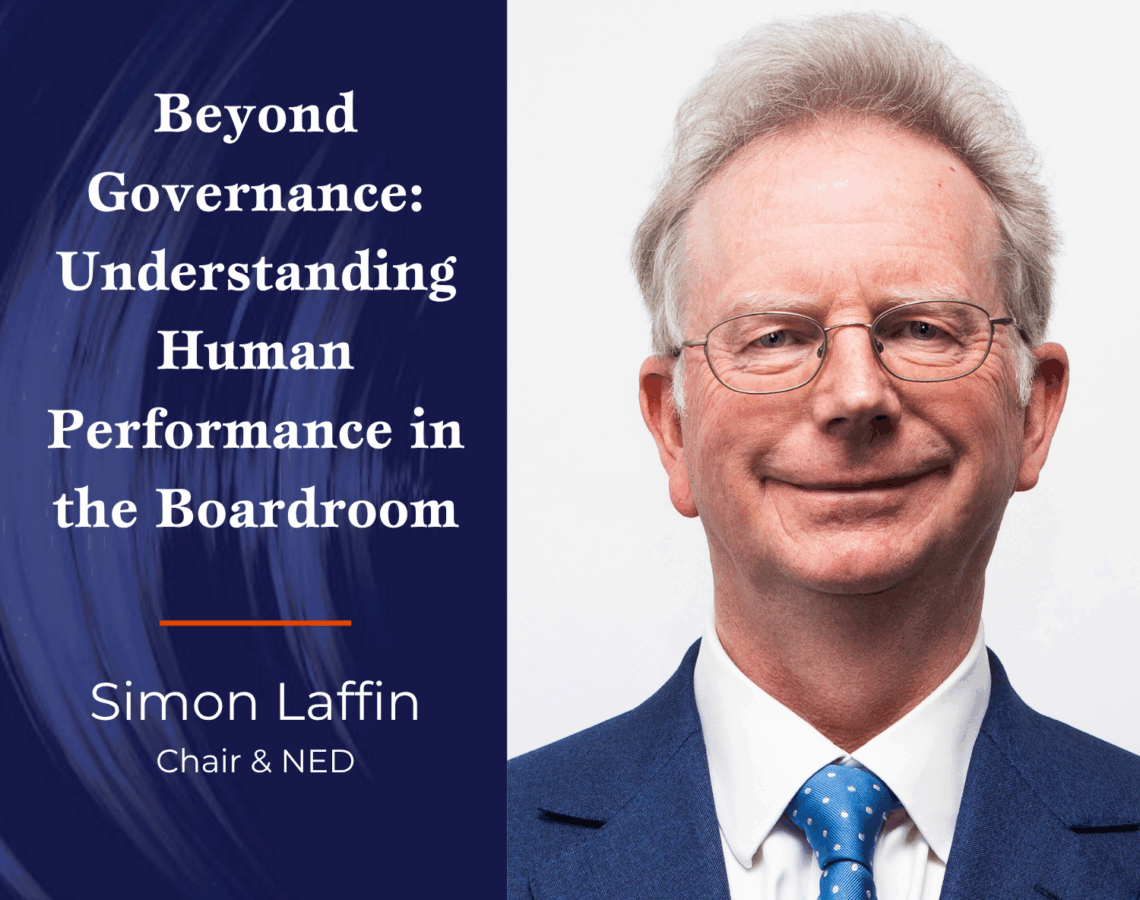
Is understanding the human performance of boards the missing dimension in board effectiveness? Drawing on insights from human factors research, this podcast discusses how communication, leadership, authority, cognitive bias, and group dynamics influence the quality of board decisions, and what directors can do differently.
In this podcast, Dr Sabine Dembkowski, Founder and Managing Partner, is joined by Simon Laffin. Simon has over 35 years of board experience as a chair, non-executive director, and adviser. He has chaired Care REIT plc, Assura plc, Flybe Group plc, and Hozelock Group. He served as a non-executive director of companies including Dentsu Group Inc., Aegis Group plc, Mitchells & Butlers plc, and Northern Rock plc, where he joined the board as part of the rescue team following the run on the bank.
“We ask the wrong questions about failure.”
When a failure occurs, Simon notes a rush to point fingers or change the rules. However, to achieve better results, human factors must be changed. This means investments and coaching around an organisation’s human capabilities, limitations, performance, and behaviour, particularly behaviour under stress.
“When I’ve looked at company failures over the last few hundred years, two things come out very strongly.”
To Simon, there are two key factors. One is leadership. Boards yearn for an ideal leader, but leadership is a situational quality that depends heavily on the team around the leader. The second factor is overconfidence. Successful companies can cross the line from justified confidence to arrogance, which fosters complacency and leads boards to miss warning signs, resulting in failure or scandal.
“We are not saying you should blame people for that. We’re saying that is how humans work.”
When failures happen, boards want a scapegoat, or to blame a person vs the framework that enabled the seeds of failure to flourish. Instead, by giving more time and space to understanding human behaviour patterns, boards can develop resilience and resistance to instinctive patterns and biases. For example, Simon advocates rigorous 360-degree feedback systems and pre-mortems for risky scenarios to bring uncomfortable issues to the forefront. This helps boards catch gaps and guard against overconfidence.
“When you do a board evaluation, boards should be thinking about their own decisions.”
In Simon’s experience and studies, too few boards reflect on their own decision-making processes. When things go well, and especially when things go badly, improvement only happens when boards understand the human behaviours that led to the adoption of a certain strategy or the tolerance of a red flag. He advocates for zero tolerance for ethics violations or conflicts of interest, careful examination of incentive structures, and moving risk assessments from the back of the business case to the forefront of the discussion.
The top three takeaways from our conversation for effective boards are:
- Governance tells us who should make decisions and how the board should operate, but human factors explain how those decisions are actually made.
- Better boards don’t eliminate uncertainty, risk, and human error, but they understand and manage them.
- The next evolution in board effectiveness will come from combining good governance with a better understanding of human performance.
Come Join the Better Boards Community
We’d love to get to know you! If you’d like to become part of the Better Boards community, discover our unique approach, and explore ways to work with us or share your ideas on The Better Boards Podcast Series, drop us a line at info@better-boards.com
Remember to subscribe and never miss an episode of the Better Boards Podcast Series. It’s available on Apple, Spotify, or Google.
To find out how you can participate in the Better Boards Podcast Series or for more information on Better Boards’ solutions, please email us at info@better-boards.com.
